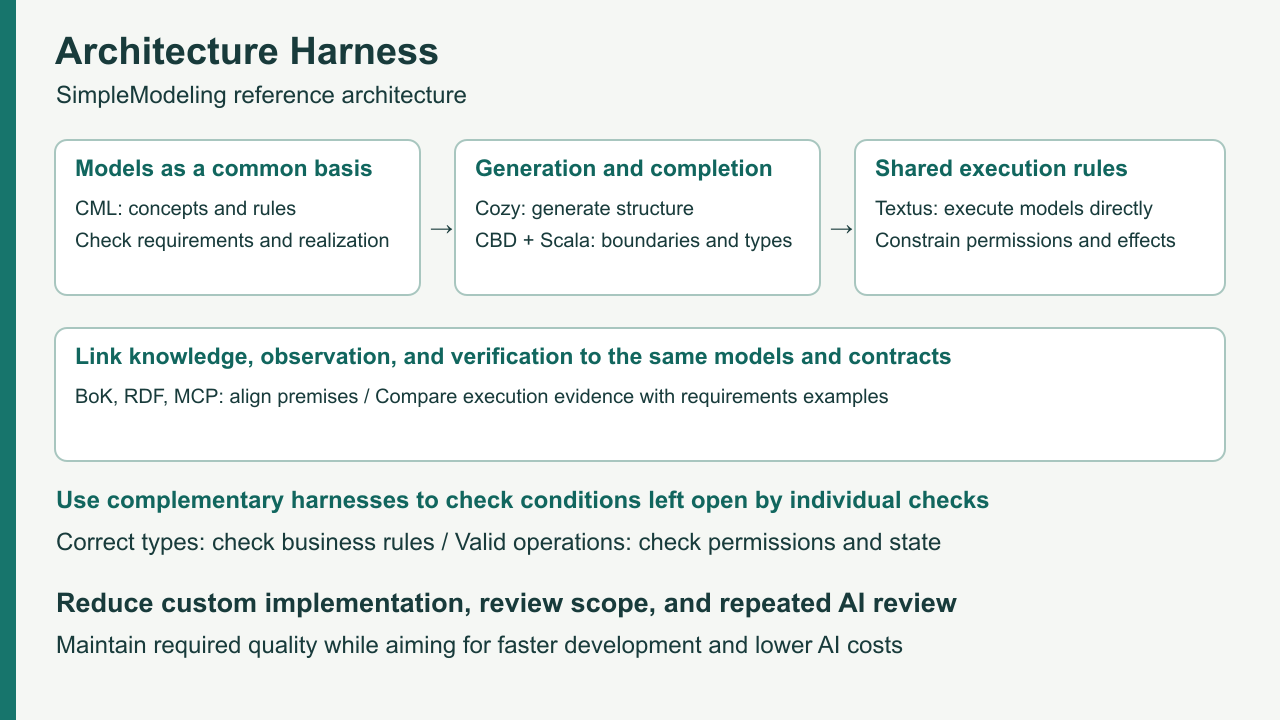
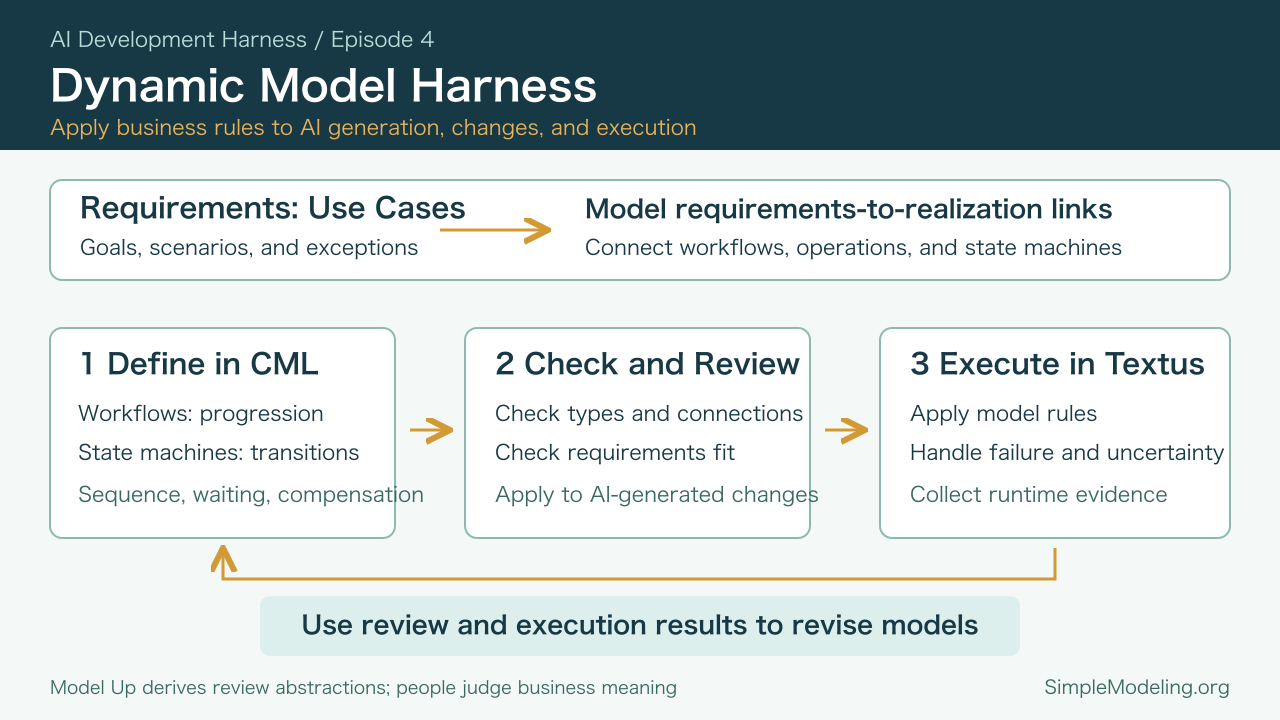
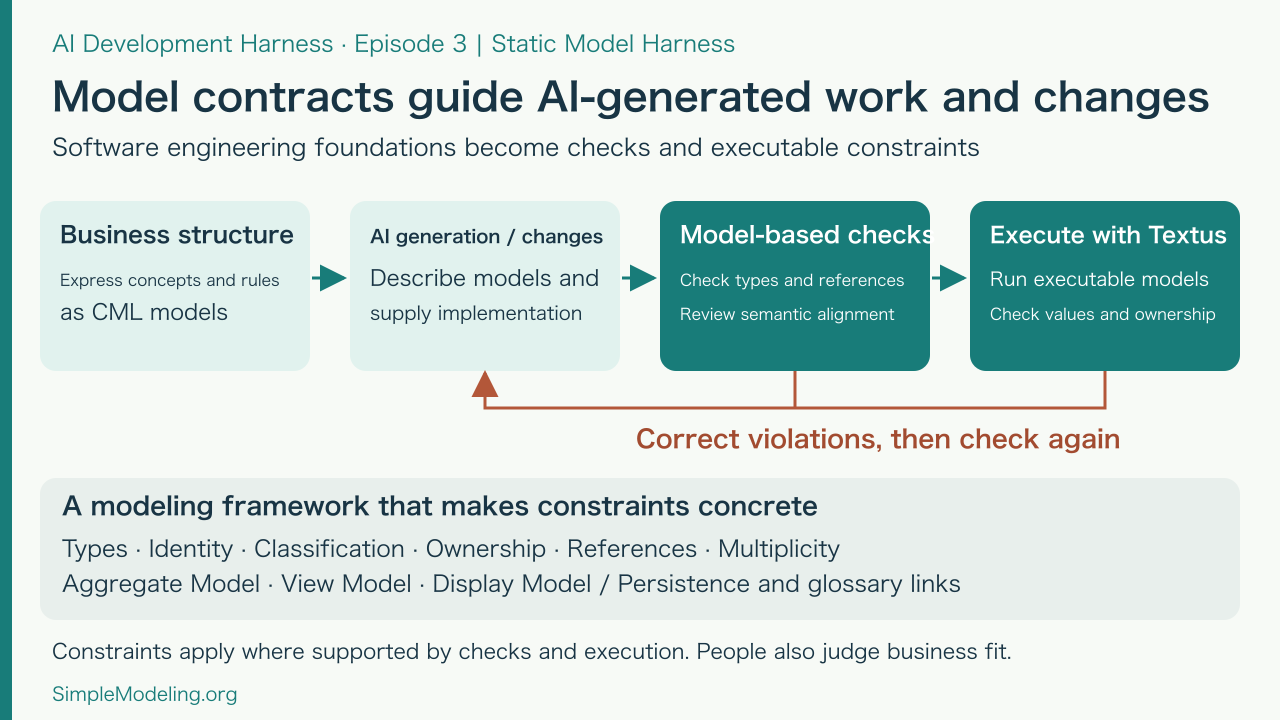
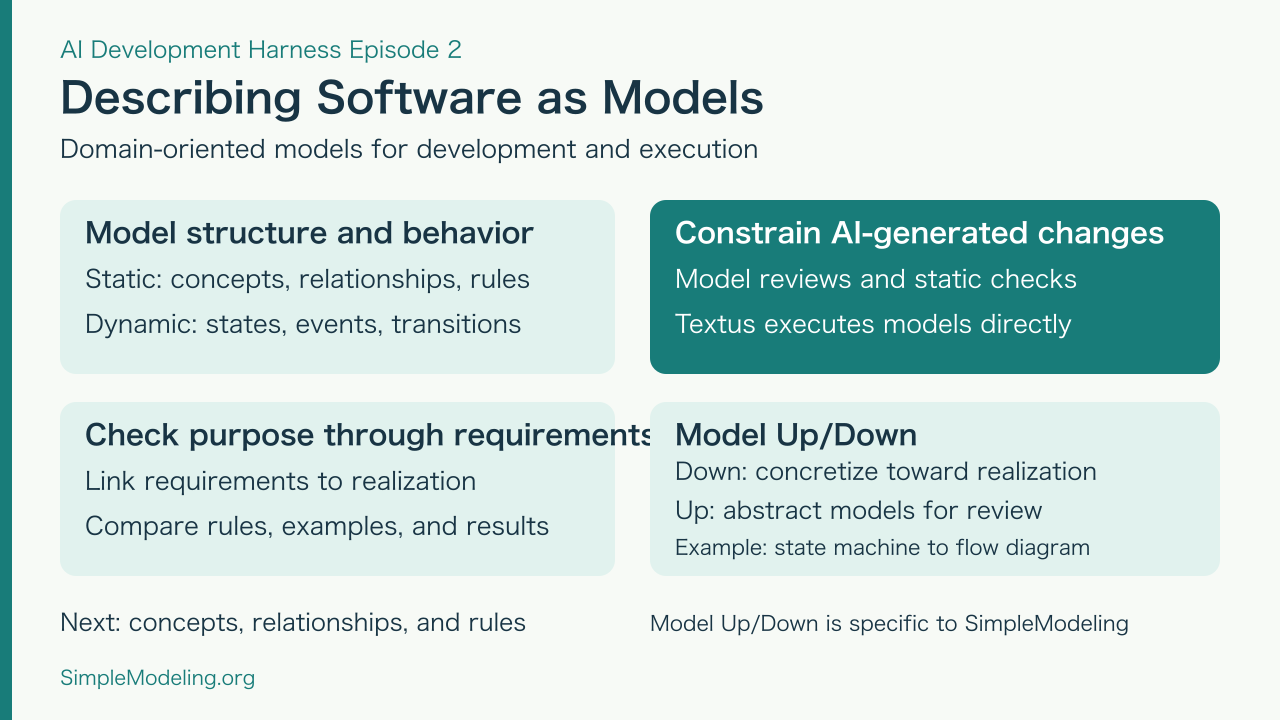
A collection of frameworks and models that define how development proceeds — from meta-process design to project execution.The Development Process section explores how modeling, knowledge, and AI collaboration shape sustainable and adaptive software creation.
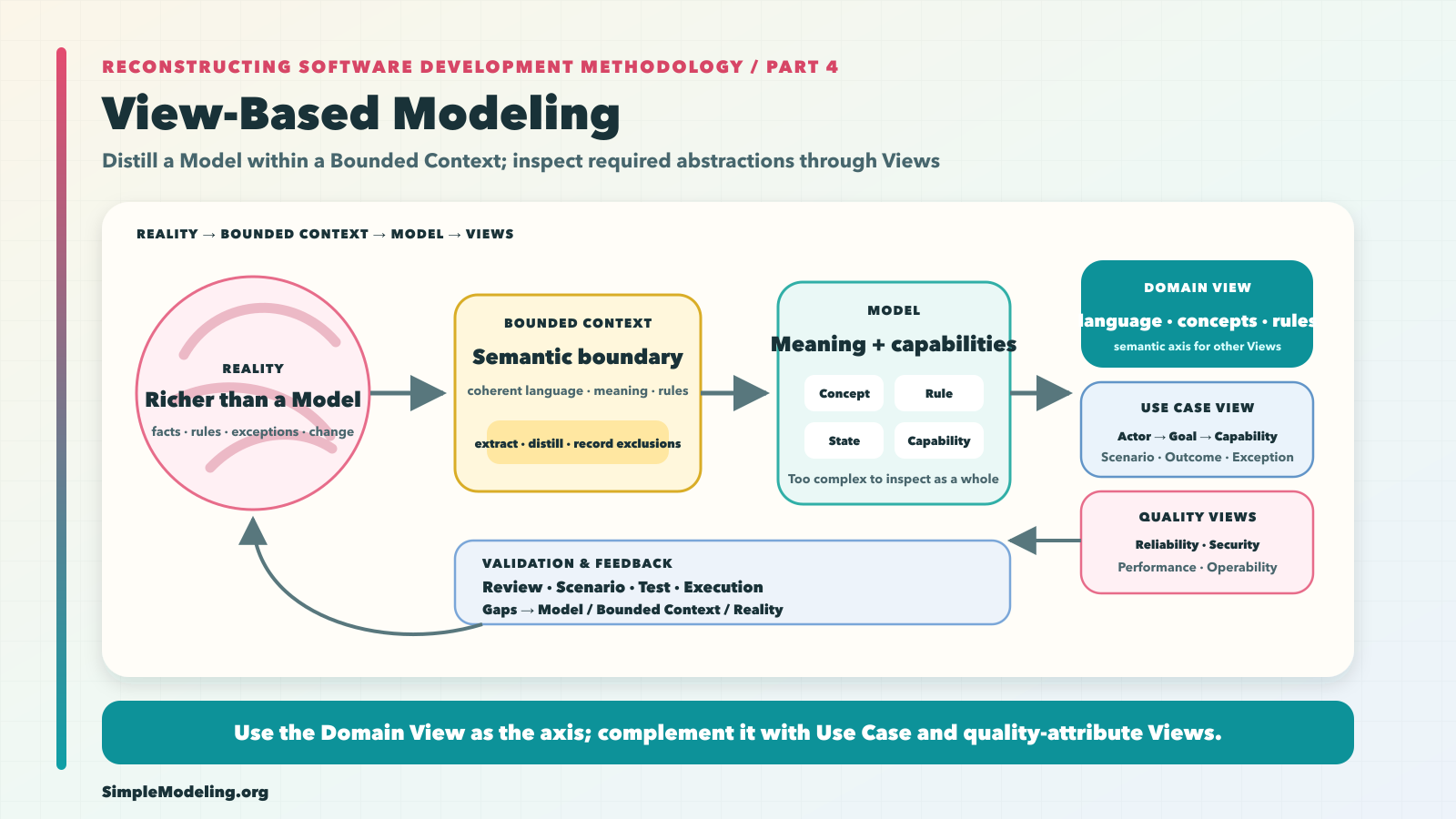
Part 4 takes the Model as its subject and composes Capabilities and Aspects through the Domain Model and Use Case Model axes. The Object Model makes the formal structure concrete, while purpose- and concern-selected Views support understanding, evaluating, and applying the complex Model.
2026-08-10
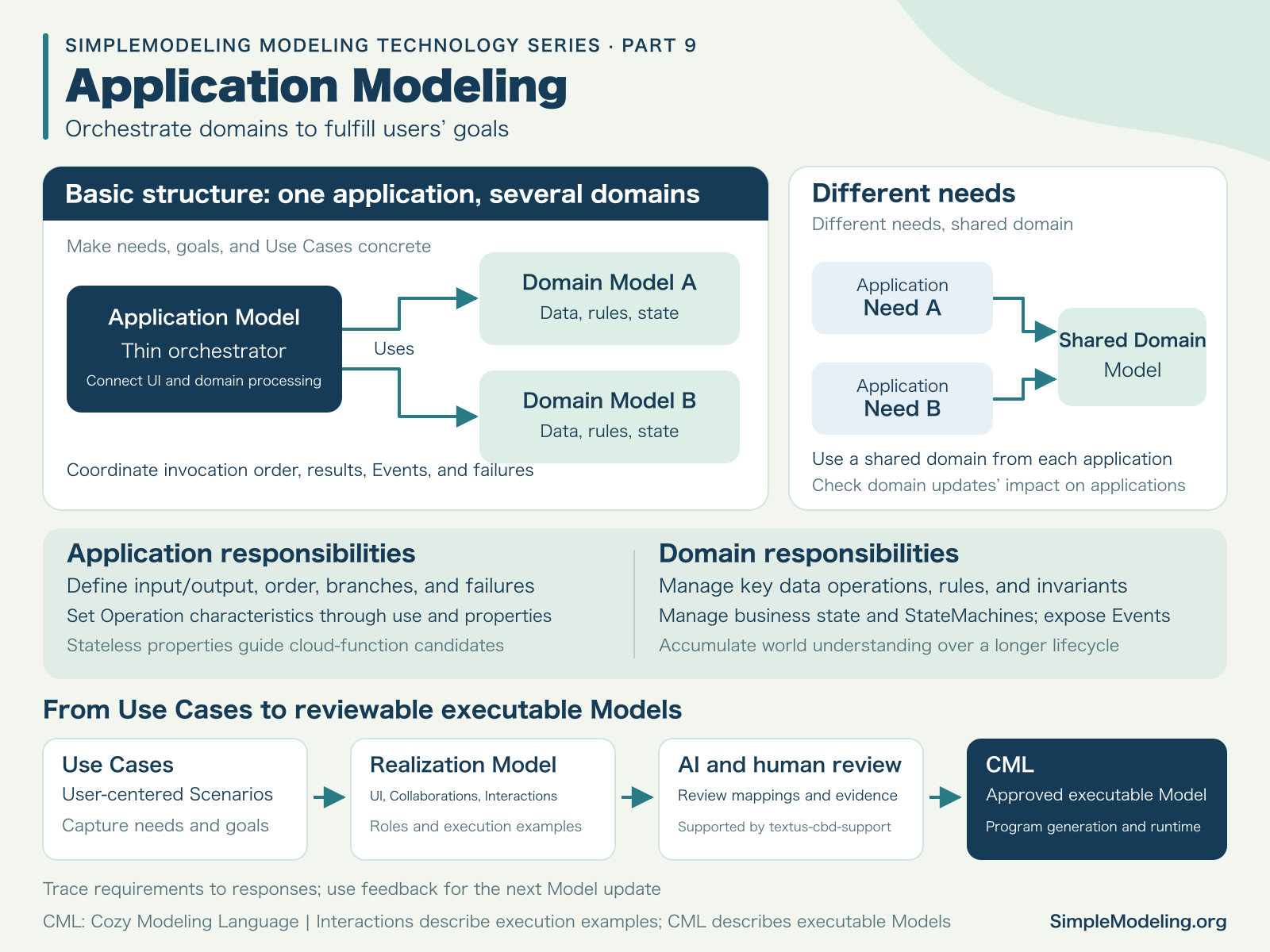
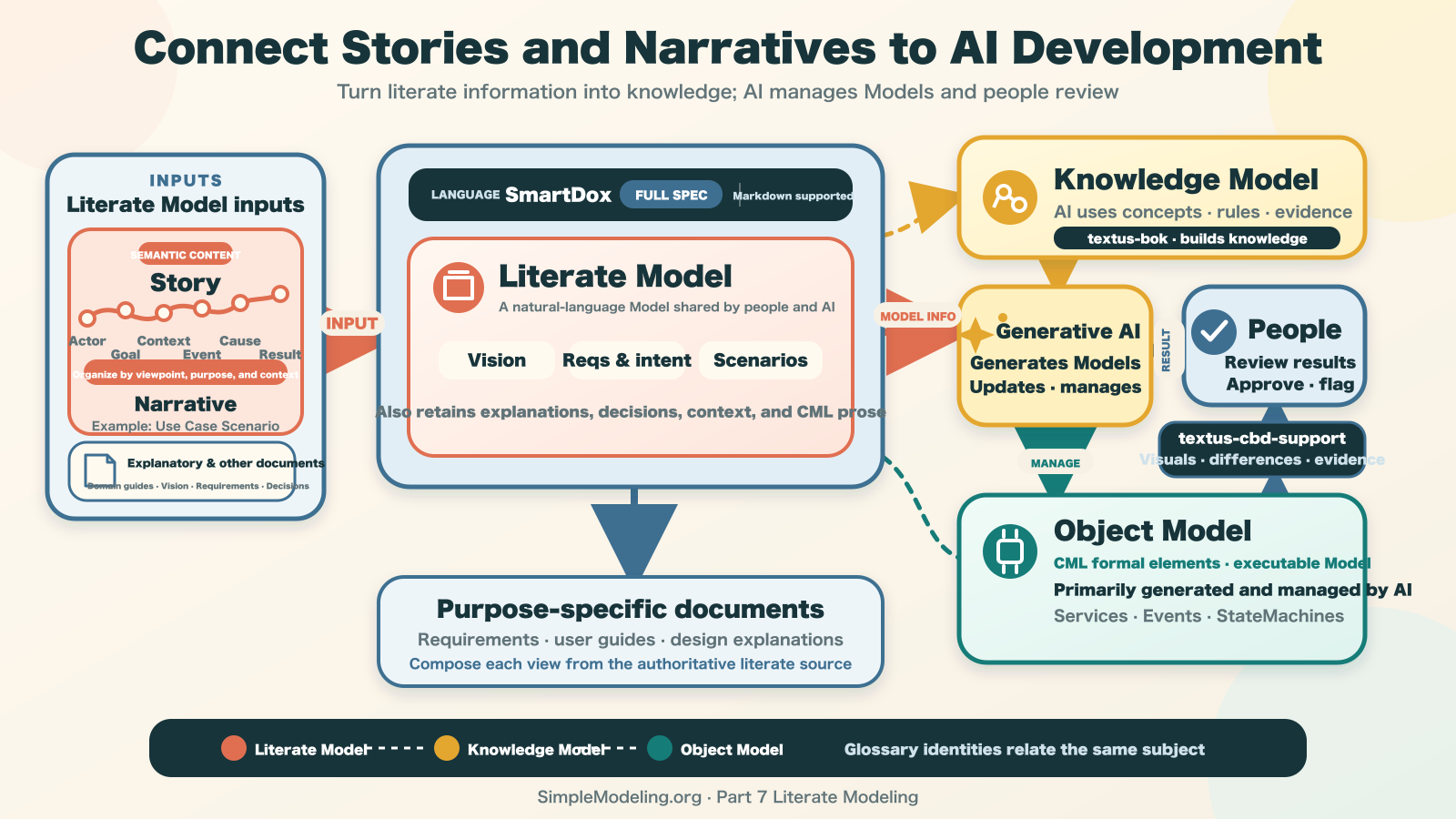
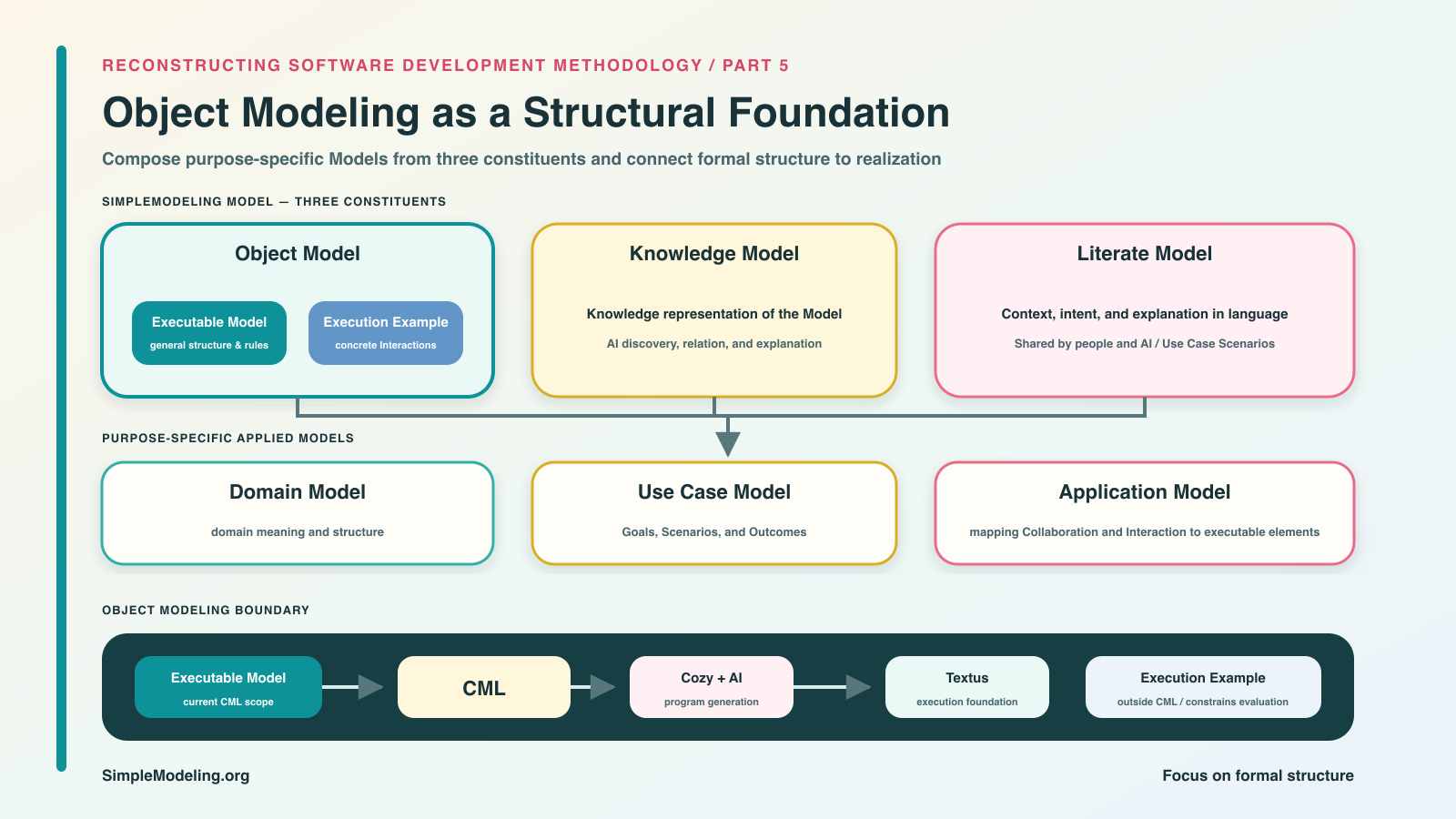
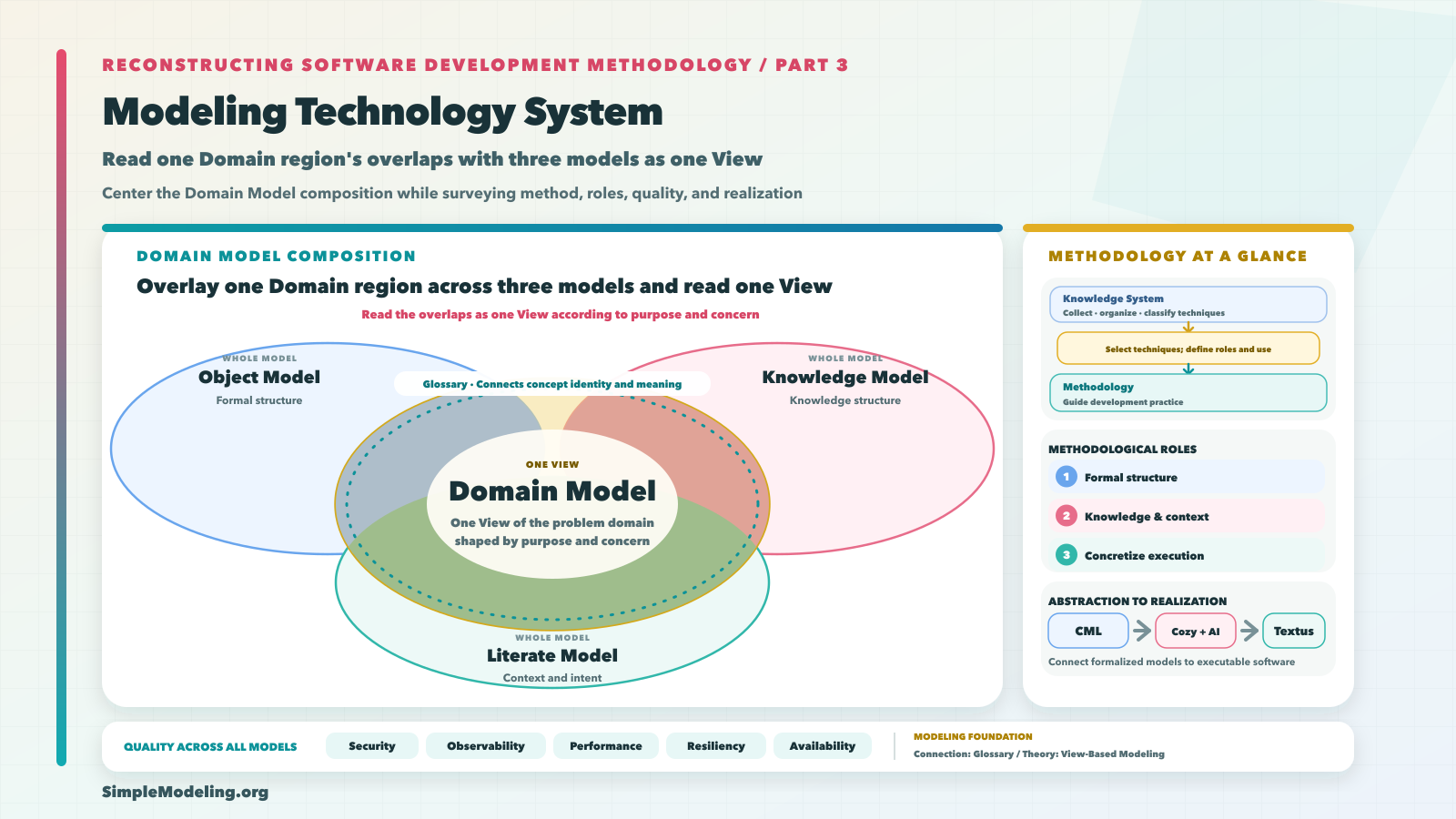
A Knowledge System collects, organizes, and classifies existing technologies and provides a map for understanding them. A Software Development Methodology selects the needed technologies from that knowledge, defines their roles and use, and guides practice. A SimpleModeling Model is composed of an Object Model for formal structure and execution examples, a Knowledge Model for generative-AI knowledge structures, and a Literate Model for human-readable context and intent. Domain Modeling organizes the three constituents with emphasis on problem-domain meaning, structure, rules, and boundaries. Application Modeling organizes them with emphasis on Use Case realization, Collaborations, Interactions, state transitions, Events, Services, and Operations. Domain Modeling is not entirely static, and Application Modeling does not own every dynamic element. Approved executable formal structures are connected to executable software through CML, Cozy, AI, and Textus as Model Realization. Quality attributes remain cross-cutting design concerns.
2026-08-03
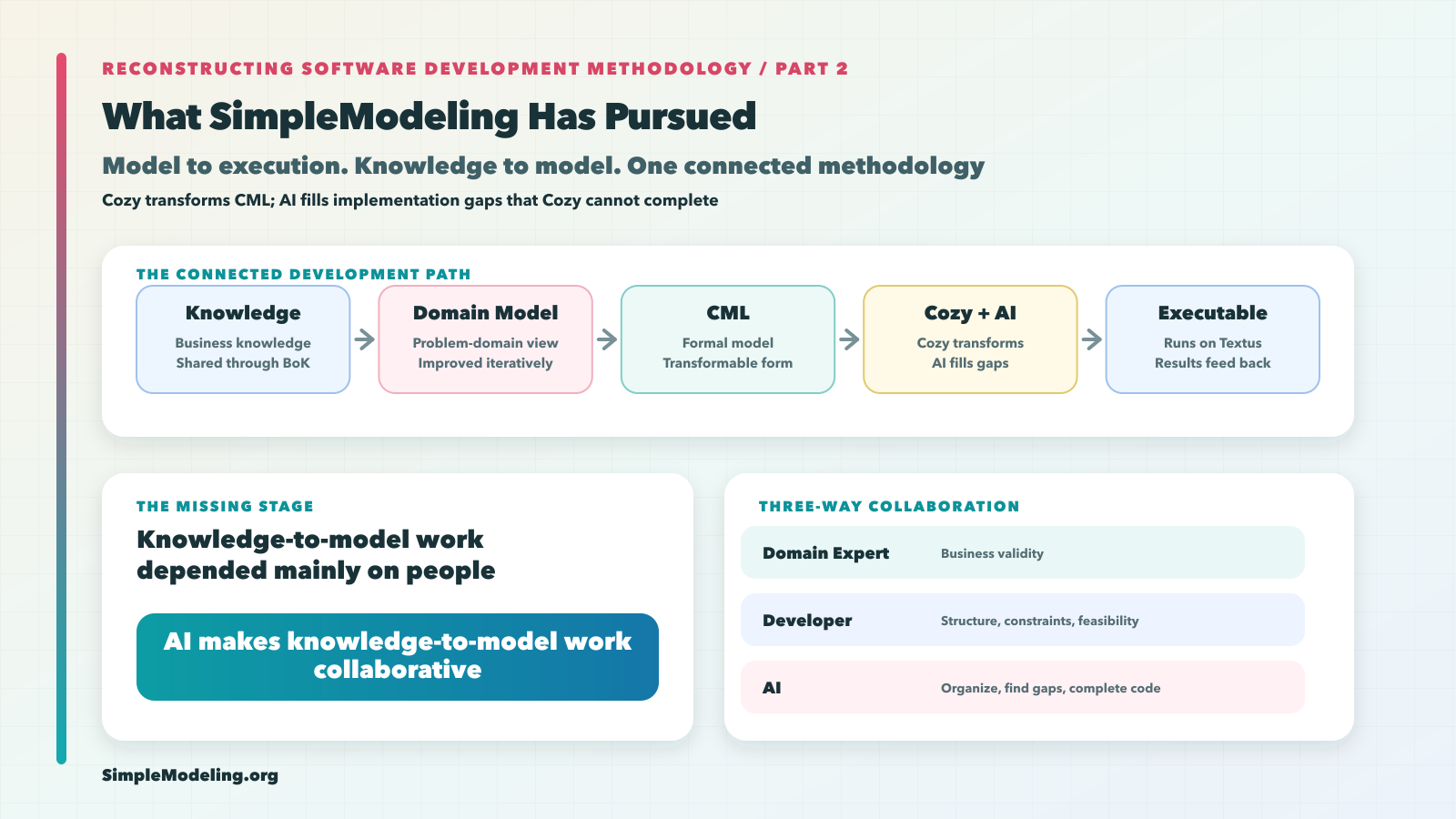
SimpleModeling has built a path from models to executable software through CML, DSLs, Literate Models, Cozy, and Textus. Cozy transforms CML into executable software, while AI fills implementation gaps that Cozy cannot transform completely. Textus runs the resulting software. Meanwhile, people have performed most of the work of constructing a Domain Model from knowledge. With the BoK as a shared foundation for collaboration among domain experts, developers, and AI, the path from Knowledge to Executable Software can be treated as one methodology.
2026-07-27
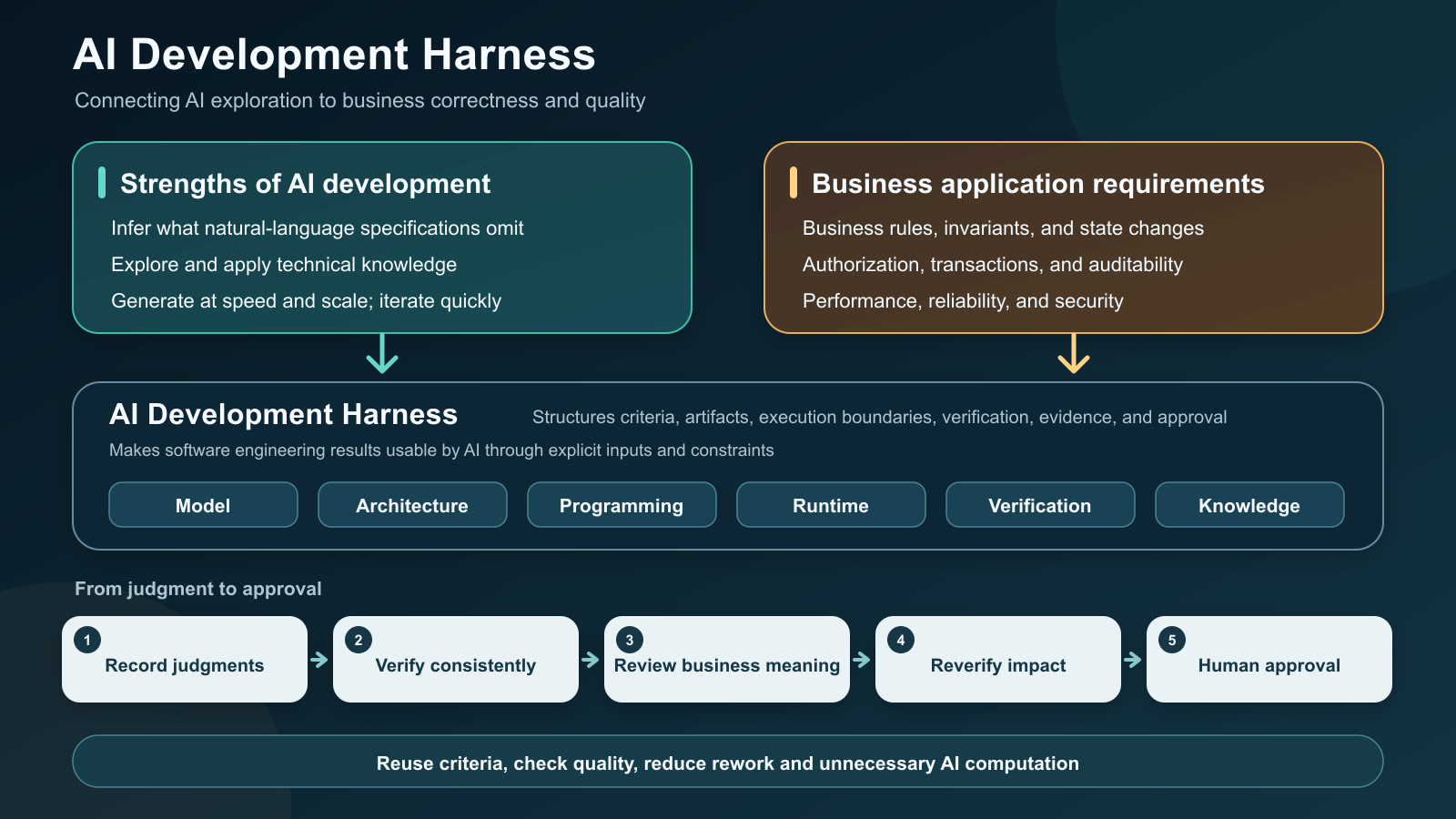
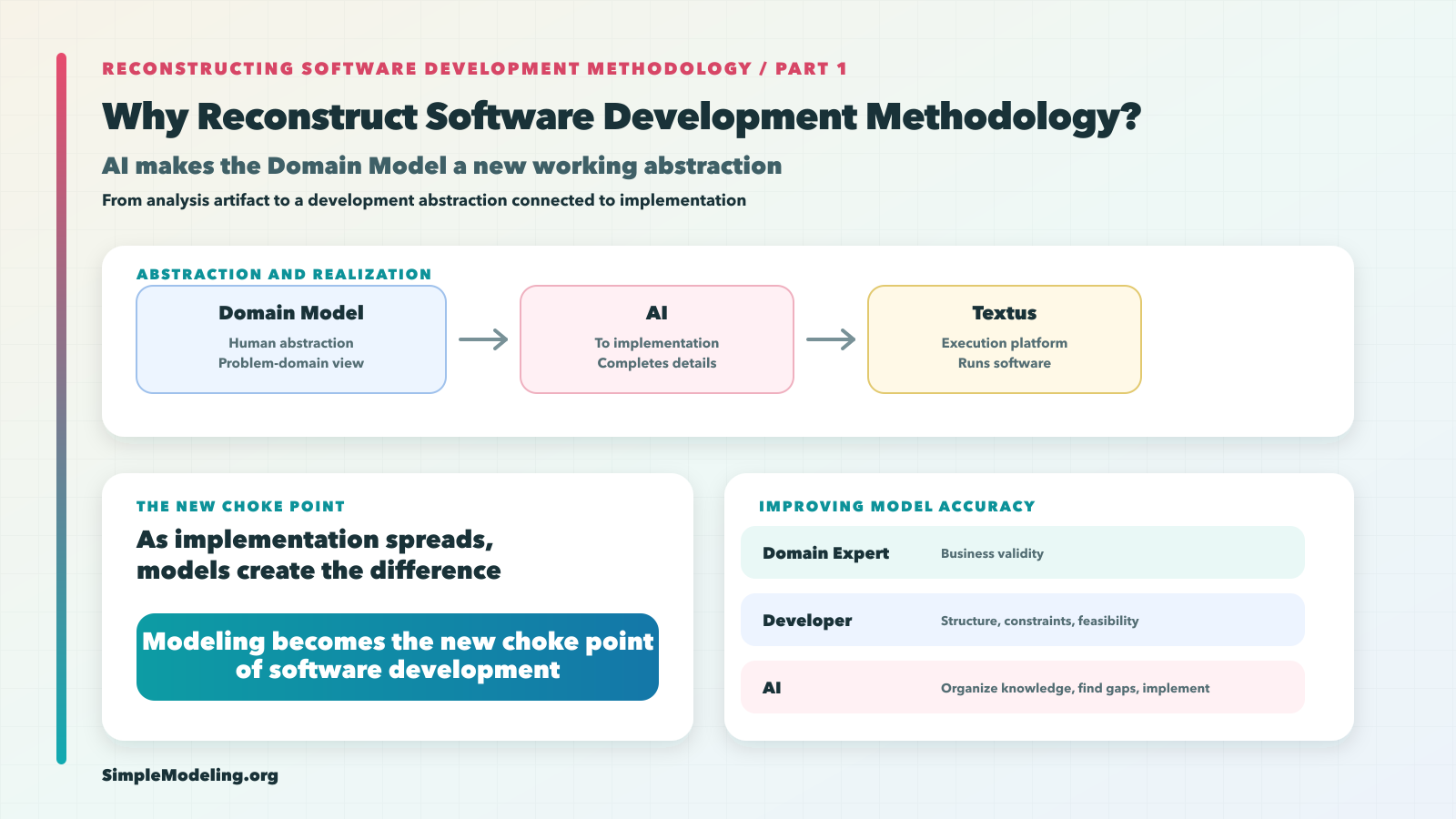
With the arrival of AI, the domain model has become a working abstraction with a realization path to implementation that can directly drive development forward. AI translates domain models into implementations and fills in the necessary implementation details. The primary subject handled by humans therefore shifts from describing implementation step by step to software models representing the target world, responsibilities, execution, and knowledge. Because model quality strongly influences software quality, modeling becomes the new choke point, requiring existing software engineering to be reconstructed as a modeling-centered methodology.
2026-07-20
SimpleModeling adopts an architecture-centric approach derived from the Unified Process. Architecture is treated not merely as a design artifact, but as the organizing structure that guides requirements, analysis, design, implementation, and operation. By applying architectural viewpoints from the earliest stages, models become more coherent, analyzable, and AI-friendly.
2026-05-11
The SimpleModeling Development Process is composed by selecting and combining Practices such as Use Case Lite, Scrum Solo, Cloud Native CBD, BoK, Cozy Domain Modeling, Code Generation, and DevOps on top of the Essence Kernel. CNCF is positioned as the execution foundation. This article provides a draft definition using Method View, Process Flow View, Work Product View, Role/Agent View, Automation View, and Lifecycle View.
2026-04-20
SimpleModeling integrates literate modeling, DSL, and execution platform to enable AI-driven development processes. This article reconstructs a minimal development workflow based on Essence as a BoK → Cozy → CNCF → SKILL pipeline.
2026-04-13
This article explains the structure and operation of the Meta Development System Framework proposed by SimpleModeling. It serves as an integrated development foundation combining Literate Model-Driven, Knowledge-Driven, and AI-Assisted approaches, modeling the way of development as a reusable development system.
2025-11-10
SimpleModeling has built a path from models to executable software through CML, DSLs, Literate Models, Cozy, and Textus. Cozy transforms CML into executable software, while AI fills implementation gaps that Cozy cannot transform completely. Textus runs the resulting software. Meanwhile, people have performed most of the work of constructing a Domain Model from knowledge. With the BoK as a shared foundation for collaboration among domain experts, developers, and AI, the path from Knowledge to Executable Software can be treated as one methodology.
2026-07-27
With the arrival of AI, the domain model has become a working abstraction with a realization path to implementation that can directly drive development forward. AI translates domain models into implementations and fills in the necessary implementation details. The primary subject handled by humans therefore shifts from describing implementation step by step to software models representing the target world, responsibilities, execution, and knowledge. Because model quality strongly influences software quality, modeling becomes the new choke point, requiring existing software engineering to be reconstructed as a modeling-centered methodology.
2026-07-20
SimpleModeling adopts an architecture-centric approach derived from the Unified Process. Architecture is treated not merely as a design artifact, but as the organizing structure that guides requirements, analysis, design, implementation, and operation. By applying architectural viewpoints from the earliest stages, models become more coherent, analyzable, and AI-friendly.
2026-05-11
The SimpleModeling Development Process is composed by selecting and combining Practices such as Use Case Lite, Scrum Solo, Cloud Native CBD, BoK, Cozy Domain Modeling, Code Generation, and DevOps on top of the Essence Kernel. CNCF is positioned as the execution foundation. This article provides a draft definition using Method View, Process Flow View, Work Product View, Role/Agent View, Automation View, and Lifecycle View.
2026-04-20
SimpleModeling integrates literate modeling, DSL, and execution platform to enable AI-driven development processes. This article reconstructs a minimal development workflow based on Essence as a BoK → Cozy → CNCF → SKILL pipeline.
2026-04-13