Entity Analysis and Design
We explore the differences between analysis models and design models of entities, which are central to domain models.
When building a design model from an analysis model, one of the key enhancements is the consideration of non-functional requirements—especially quality attributes.
However, there are also aspects of the structural model itself that require extension.
A representative example is the introduction of purpose-specific objects used to manipulate entities.
This article delves into design strategies and architecture for representing entities in programs, as well as the potential for their automated generation.
Programmatic Representation of Entities
The SimpleModeling Reference Profile adopts Scala as the programming language.
Therefore, entity design is realized as Scala code.
Limitations of Simple Mappings
The following diagram illustrates an example of an input/output architecture that uses a single value object to operate on an entity.
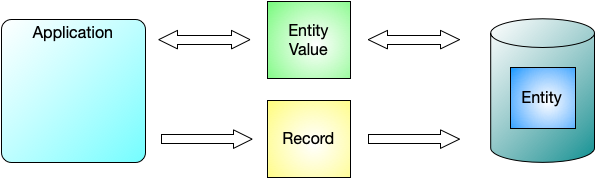
When using a value object, data updates often require an inefficient process of reading, overwriting, and writing back the data.
Furthermore, using a generic record type at the cost of type safety reduces the reliability of the program.
Using the same value object for different purposes can lead to mismatches with usage contexts and require unnecessary consideration.
Data Operation Architecture
The diagram shows the data operation architecture adopted in SMRP.
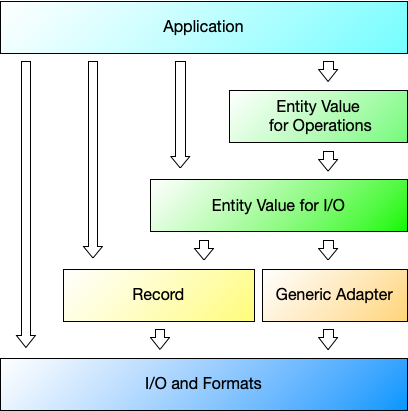
When performing input/output for entities, applications can choose from the following options:
-
Use operation-specific entity values
-
Use I/O-specific entity values
-
Use record functionality
-
Directly use platform-level features
The higher the abstraction level of the function used, the greater the programming ease and reliability through type safety.
Record
SMRP provides generic record objects for flexible data handling.
Defining dedicated Scala classes for every specific use case can be cumbersome and time-consuming. Moreover, having too many similar but subtly different classes may increase the likelihood of introducing bugs.
Record objects serve as a flexible fallback for handling such edge cases.
The following types of record objects are provided in the SimpleModelingLib:
-
org.simplemodeling.record.Record
Purpose-Specific Classes for Entities
In analysis models, an entity is typically defined as a single class, but in design models, it is desirable to define multiple purpose-specific classes with mutual convertibility.
For simple applications, a one-to-one mapping between entity and Scala class may suffice, but as the application grows in complexity, multiple Scala classes per purpose become necessary.
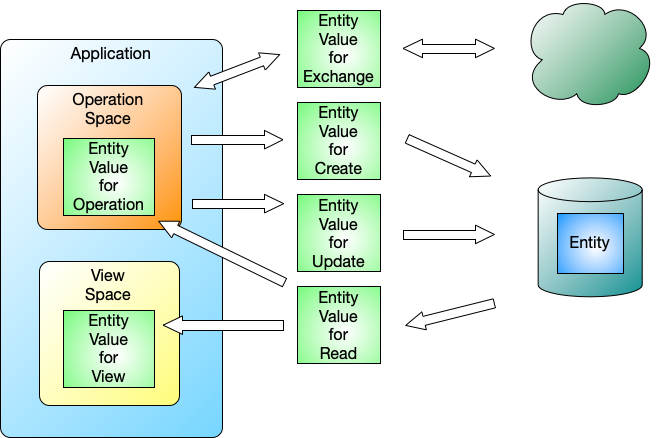
While the analysis model represents an entity with a single class, the design model must provide multiple purpose-specific classes and ensure convertibility among them.
Primary Use Categories
-
For logic processing
-
For view
-
For entity operations
-
Read
-
Create
-
Update
-
Bulk update (omitted in diagram)
-
-
For external integration
Placement in Model Spaces
In the operation space of the application, value objects for logic processing are placed (shown as Entity Value for Operation in the diagram).
In the view space, value objects for external presentation are placed (Entity Value for View).
For entity operations, the following value objects are designed for each specific purpose:
-
For reading: Entity Value for Read
-
For creation: Entity Value for Create
-
For update: Entity Value for Update
-
For bulk update: omitted in the diagram
For external integration, Entity Value for Exchange is provided.
Example of an Analysis Model
In SimpleModeling, design models are created from analysis models written in CML, following the concept of Analysis Model Up/Down.
The following source shows an example of the analysis model Reservation described in CML.
Reservation
===========

# Entity

## Reservation

### Attribute

| name       | type                    | mul |
|------------+-------------------------+-----|
| id         | identifier              |   1 |
| name       | name                    |   1 |
| description| description             |   ? |
| resourceId | ResourceId              |   1 |
| interval   | Interval[ZonedDateTime] |   1 |
| reserver   | UserId                  |   1 |
Implementation of the Analysis Model in Scala
When directly implemented as a Scala object, the analysis model takes the following form:
case class Reservation(
  id: Reservation.Id,
  name: Reservation.Name,
  description: Option[Reservation.Description],
  resource: ResourceId,
  interval: Interval[ZonedDateTime],
  reserver: UserId
)
Design Model
Let us define the following purpose-specific Scala objects derived from the analysis model:
-
For logic processing
-
For view
-
For entity operations
-
Read
-
Create
-
Update
-
Bulk update
-
-
For external integration
Logic Processing
In CQRS commands, complex domain logic is executed primarily around update operations.
These operations manipulate entities in-memory. Thus, it is necessary to define a class that contains sufficient information to support complex in-memory domain logic.
case class Reservation(
  id: Reservation.Id,
  name: Reservation.Name,
  description: Option[Reservation.Description],
  resource: Resource,
  interval: Interval[ZonedDateTime],
  reserver: User
)
Information required for logic processing must be expanded from referenced objects and held as value data within the class.
However, it is not necessary to expand all information from referenced objects. Only the information that is safe for external exposure should be retained. It does not need to be as strictly curated as view-specific classes.
For example, the attribute user is held as an expanded value User, rather than just a data type like UserId.
View-specific classes also expand and retain referenced object contents in a similar manner.
View
Cloud-native applications inevitably adopt a CQRS architecture. In CQRS, views are prepared as data representations for queries.
This requires value objects specifically designed for entity views.
case class Reservation(
  id: Reservation.Id,
  name: Reservation.Name,
  description: Option[Reservation.Description],
  resource: Resource,
  interval: Interval[ZonedDateTime],
  reserver: User
)
Information required for view queries must be expanded from referenced objects and stored as value fields. However, it is not necessary to expand all information from the referenced objects. Only the information that can be safely exposed externally should be retained.
For example, the resource attribute is stored as a value Resource instead of the data type ResourceId.
Similarly, the user attribute holds an expanded value User instead of UserId.
Entity Operation
These are value objects designed to perform operations on entities persisted in a database.
Read
Scala class used when loading a single entity from the database.
To enhance compatibility with the database, it is constructed primarily using basic data types.
case class Reservation(
  id: String,
  name: String,
  description: Option[String],
  resource: String,
  interval: String,
  reserver: String
)The interval attribute is internally an Interval of ZonedDateTime, but is stored as a String (encoded as XML or JSON) for database compatibility.
The read class uses Option types in accordance with the analysis model definition.
Create
Scala class used when creating a new entity.
Required fields must be explicitly provided; optional fields are defined using Option.
case class Reservation(
  id: String,
  name: String,
  description: Option[String],
  resource: String,
  interval: String,
  reserver: String
)
Update
Scala class used for updating an entity.
The ID is a required attribute, and all other updatable fields are defined using Option.
case class Reservation(
  id: String,
  name: Option[String],
  description: Option[String],
  interval: Option[String]
)
In practice, using only the Option type makes it ambiguous whether a field should be ignored in the update or explicitly set to NULL to delete its value.
Bulk Update
Scala class used for bulk updates based on matching conditions, without using entity IDs.
case class Reservation(
  name: Option[String],
  description: Option[String],
  interval: Option[String]
)
It has a structure similar to the Update class, but omits the id attribute.
It is used to update all entities that match conditions other than id.
External Integration
When integrating with external systems, Scala classes must be converted to and from various formats such as XML, JSON, YAML, etc.
-
XML
-
JSON
-
YAML
-
HOCON
-
Properties
-
gRPC IDL
Since manually implementing these conversions is costly, generic data transformation libraries are used whenever possible.
The SimpleModeling reference profile adopts Circe from the Cats ecosystem.
case class Reservation(
  id: String,
  name: String,
  description: Option[String],
  resource: String,
  interval: String,
  reserver: String
)
As with database integration, attributes are kept to basic types to simplify conversion mapping across formats.
Even for formats not natively supported by Circe, integration is relatively easy when using these structured Scala classes.
Literate Model-Driven Development
Thus far, we have examined the correspondence between analysis and design models in domain modeling, focusing particularly on entity persistence.
To enable type-safe entity operations, it is necessary to define multiple value objects for a single entity, each tailored to a specific purpose.
Manually coding these classes is a labor-intensive task, but this challenge can be addressed through programmatic code generation.
In SimpleModeling, the model compiler "Cozy" automatically generates the following purpose-specific design model classes (in Scala) from analysis models written in CML:
-
Logic processing
-
Entity operations
-
Read
-
Create
-
Update
-
Bulk update
-
-
External integration
Summary
This article focused on the differences between analysis and design models of domain entities, clarifying the structure and roles of purpose-specific value objects through design strategies and concrete Scala implementations.
We demonstrated that by preparing optimized classes for each use case—view, logic processing, operation, and external integration—it is possible to achieve both type safety and development efficiency.
Furthermore, within the framework of Literate Model-Driven Development, we introduced how leveraging automatic generation via Cozy makes this design approach sustainable and scalable.
Looking ahead, further developments such as application to other domains, expansion of generation targets, and integration with UI models and API specifications are anticipated.
References
Glossary
- Domain Model
-
Undefined
- Quality Attribute
-
A Quality Attribute is a characteristic that expresses the degree of quality with which software satisfies requirements in addition to performing its functions. Examples include Security, Performance, Availability, Reliability, Resilience, Observability, and Maintainability.
- Operation
-
In UML, an Operation is a Behavioral Feature of a Classifier that specifies the name, type, Parameters, and Constraints for invoking associated Behavior. The Operation specifies an invocation contract, while a Method or another Behavior realizes it.
- SimpleModeling Reference Profile (SMRP)
-
This is the reference profile of SimpleModeling. To concretely illustrate Literate Model-Driven Development with SimpleModeling, a reference profile is defined.
- Scala
-
Undefined
- value object
-
A Value Object is an object in a domain model that represents a semantically meaningful group of values, such as attributes or descriptions. It does not have a persistent identity like an entity, is immutable, and equality is based on its values.
- Reliability
-
Reliability is the quality by which a system consistently performs required functions under specified conditions for a specified period. It is evaluated through concerns including Availability, Fault Tolerance, and Recoverability.
- type safety
-
Type safety refers to the property of a programming language or system where operations are guaranteed to be used with values of the correct type. Type-safe code prevents invalid operations by detecting type mismatches at compile time (or runtime), reducing runtime errors and unexpected behaviors. Scala ensures type safety through strong static typing combined with type inference, enabling expressive yet safe programming.
- Platform
-
A Platform is a shared set of technical foundations and services used to build, deploy, execute, and operate software.
- Class
-
Undefined
- bug
-
A colloquial term referring to software problems. It has no strict technical definition and is often used broadly to cover Defects, Faults, or Failures.
- View
-
A View is a representation that projects selected parts of a Model according to a particular Purpose and Concern so they can be understood, reasoned about, evaluated, or used. A View presents part of a Model and does not own meaning independently of the source Model.
- CML (Cozy Modeling Language)
-
CML (Cozy Modeling Language) is the SimpleModeling formal modeling language for describing the Executable Model portion of an Object Model that connects to program generation and execution.
- Analysis Model Up/Down
-
Analysis Model Up/Down is a bidirectional modeling approach in which the analysis model serves as the central layer, enabling upward derivation into conceptual or design models ("Up") and downward transformation into implementation artifacts such as code or data definitions ("Down").
- SimpleModeling
-
SimpleModeling is a modeling-centered software development methodology and technology system for constructing a Domain Model from Knowledge, formalizing it in CML, realizing it as executable software through Cozy and AI, and running it on Textus.
- Model
-
A Model is an abstraction that represents a subject according to a particular Purpose and Concern so that it can be understood, reasoned about, evaluated, or constructed. It is not the subject itself; it preserves the elements, relationships, and meanings required for its purpose.
- Data Type
-
In UML, a Data Type is a Classifier whose Instances are identified by value rather than Identity. Instances of a Data Type are indistinguishable when they have the same value.
- Attribute
-
An Attribute is a Structural Feature representing a value or reference that Instances of a Classifier may hold. An Attribute may be characterized by a name, Type, Multiplicity, default value, and Constraints.
- Object
-
An Object is an Instance classified by a Class or another Classifier and may have structure, State, and Behavior. It is treated as an individual that can be referred to separately from other Instances of the same Classifier.
- Persistence
-
Undefined
- Type
-
Undefined
- Cozy
-
Cozy is the SimpleModeling toolchain that analyzes Models expressed in CML and other DSLs and transforms them into realization artifacts such as programs, configuration, and documentation.
- Literate Model-Driven Development (LMDD)
-
Literate Model–Driven Development (LMDD) is a software development methodology that integrates natural-language narrative and formal model structure within a unified text-based framework. It extends conventional Model–Driven Development (MDD) by treating documentation and models as a single, consistent source of truth. In LMDD, the descriptive and structural elements of development artifacts are expressed together using the SmartDox language. From this unified representation, ModelDox extracts structural data, CML (Cozy Modeling Language) defines domain-specific models, and Cozy generates executable code, documentation, and configuration artifacts. Artificial intelligence participates in the LMDD process by analyzing the narrative context, validating structural consistency, and supporting the refinement of models and generated artifacts. All artifacts are represented in text form, ensuring traceability, version control, and interoperability within standard development environments. By defining a formally connected and machine-interpretable relationship between documentation, design, and implementation, LMDD provides a foundation for AI-assisted model–driven engineering where human authorship and automated reasoning operate on the same representational layer.