AI Knowledge Creation Architecture: Toward a Next-Generation SECI Model
In this article, we reorganize the processes of knowledge activation, assimilation, expression, promotion, and circulation that occur when using generative AI, and clarify how human/organizational knowledge creation connects with AI-based knowledge generation.Our objective is to redraw the knowledge-creation spiral for the AI era, centered on the two-layer structure of AI tacit knowledge and the Body of Knowledge (BoK).
Generative AI Referene Architecture
In 📄 AI Collaboration Architecture, we defined the following reference architecture for generative AI.
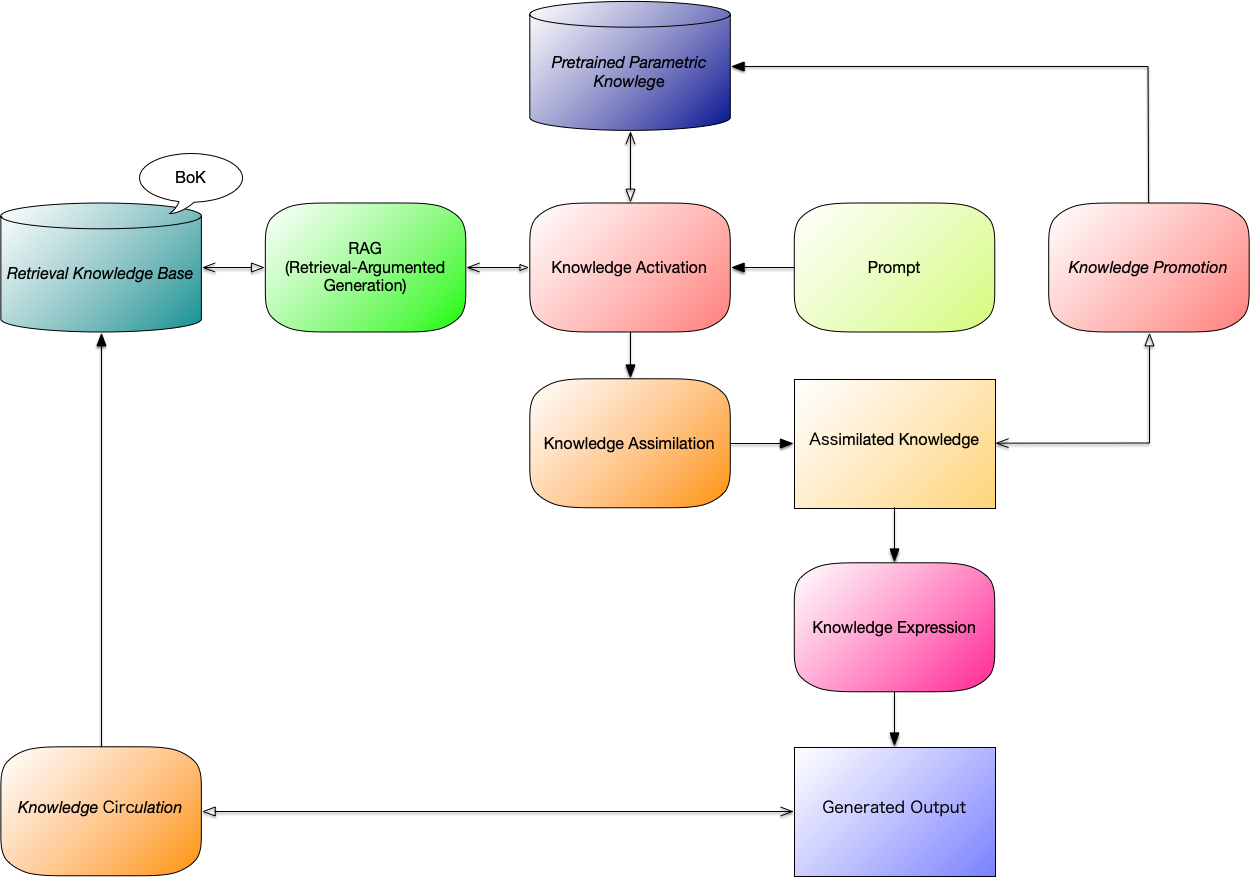
This clarifies the architecture and terminology on the generative-AI side in order to advance discussions on AI utilization within SimpleModeling.
In this article, we use this reference architecture as the starting point to examine the knowledge-creation architecture in SimpleModeling.
The generative-AI reference architecture consists of the following processes:
-
Knowledge Activation
-
Knowledge Assimilation
-
Knowledge Expression
-
Knowledge Circulation
Knowledge Activation
Triggered by a prompt input, this process integrates pretrained parametric knowledge with the retrieval knowledge base to form an internal context usable by the AI.
-
Pretrained Parametric Knowledge: The pretrained LLM that the AI already possesses
-
Retrieval Knowledge Base: External knowledge retrievable via RAG (BoK in SimpleModeling)
These elements are integrated with the prompt to produce a contextual representation that precedes knowledge assimilation.
-
Input :: Generative-AI context - Output :: Assimilated knowledge - Next Process :: Knowledge Expression - Related Process :: Knowledge Promotion === Knowledge Assimilation
Based on the context produced during knowledge activation, this process forms the AI’s internal semantic structure. The assimilated knowledge obtained here corresponds to “understanding” for the AI.
-
Input :: Generative-AI context - Output :: Assimilated knowledge - Next Process :: Knowledge Expression - Related Process :: Knowledge Promotion Knowledge promotion is the process of updating parts of this assimilated knowledge into the AI’s tacit knowledge.
Knowledge Expression
Based on the assimilated knowledge, this process generates externalized representations such as documents, code, and structured data. The generated artifacts are output externally, evaluated by humans/organizations, and treated as explicit knowledge.
-
Input :: Assimilated knowledge - Output :: Generated artifacts - Related Process :: Knowledge Circulation === Knowledge Promotion
Knowledge promotion is the process of restructuring knowledge obtained through generation or interaction and persistently integrating it into the pretrained parametric knowledge of the model.
A portion of the assimilated knowledge is incorporated as AI tacit knowledge and solidifies as internal weights of the model.
-
Input :: Assimilated knowledge - Output :: Pretrained parametric knowledge In practice, the following methods are included:
-
Fine-tuning
-
Distillation
-
Re-structuring external knowledge
-
Long-term memory accumulation
-
Knowledge circulation is a concept introduced in SimpleModeling. From the artifacts generated by AI—documents, code, structured data, and more— valuable knowledge fragments recognized by humans are circulated back into the BoK and reorganized into explicit knowledge reusable by AI.
-
Input :: Generated artifacts - Output :: Retrieval knowledge base The following tasks are mainly performed here:
Through this, the explicit-knowledge layer jointly referenced by humans and AI continues to evolve.
AI Knowledge Creation Architecture
The following diagram presents the AI Knowledge Creation Architecture of SimpleModeling, created based on the generative-AI reference architecture.
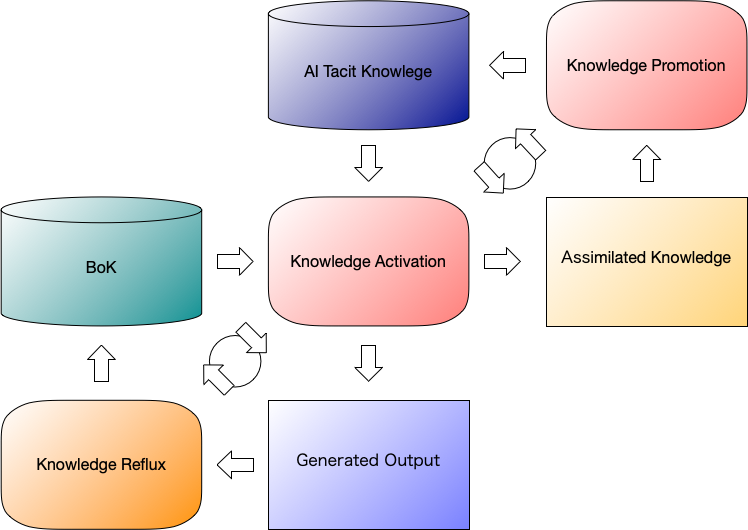
Because pretrained parametric knowledge is a technical notion, we introduce the more abstract concept of AI tacit knowledge.
AI tacit knowledge is the tacit knowledge residing inside the AI. Its content is not directly observable from the outside; its existence is inferred from the AI’s reactions to certain stimuli.
In SimpleModeling, the retrieval knowledge base is implemented as the BoK. The BoK is explicit knowledge organized around literate models.
The key point is that knowledge expressed in natural language—readable by humans—is also interpretable by AI, making it a layer of explicit knowledge shared between humans and AI.
When a prompt is applied to both AI tacit knowledge and the BoK, the knowledge activation process begins, leading to generated output. This constitutes the fundamental mechanism of generative AI.
In the generative-AI reference architecture, the feedback from generated outputs into the knowledge base was called “knowledge circulation.” However, in the AI Knowledge Creation Architecture, we emphasize that the output returns to the BoK and therefore adopt the term “knowledge reflux.”
Centered on knowledge activation, two knowledge-update loops are formed:
-
The loop that updates AI tacit knowledge through knowledge promotion
-
The loop that updates explicit knowledge (the BoK) through knowledge reflux
We call the entire set of knowledge operations—encompassing both tacit-knowledge updates and explicit-knowledge updates—the AI Knowledge Creation Architecture.
SECI Model
The SECI model is a process model in which new knowledge emerges through the mutual transformation of tacit and explicit knowledge.
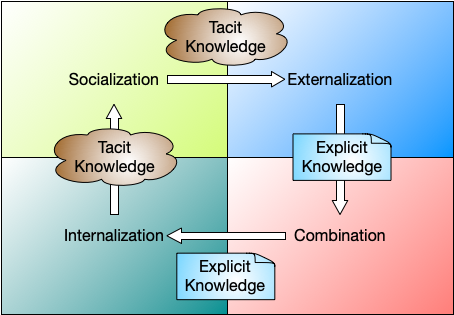
The SECI model consists of the following four phases:
-
Socialization :: Sharing tacit knowledge and forming shared experiences. - Externalization :: Converting tacit knowledge into explicit knowledge such as language or models. - Combination :: Integrating explicit knowledge and reconstructing it into a systematic body of knowledge. - Internalization :: Acquiring externalized explicit knowledge through practice and incorporating it as new tacit knowledge. From the viewpoint of tacit and explicit knowledge, the process can be organized as follows:
-
Explicit knowledge internalized as tacit knowledge by individuals or organizations (internalization) is shared through organizational activities (socialization), forming collective tacit knowledge, which is then externalized again as explicit knowledge - Tacit knowledge externalized into explicit knowledge is reorganized into a systematic body of knowledge (combination), and then re-internalized as tacit knowledge (internalization) These phases circulate spirally and lead to the emergence of new knowledge.
Comparison with the SECI Model
In knowledge creation for the AI era, tacit knowledge divides into the following two layers:
-
Tacit knowledge held by humans/organizations 2. Tacit knowledge held by the AI as its internal state In SimpleModeling, explicit knowledge is realized as the BoK, forming an explicit-knowledge layer shared by both humans and AI.
Through the BoK, the following loops are formed.
-
Human/organizational tacit knowledge → externalized into the BoK → internalized by AI → growth of AI tacit knowledge - AI tacit knowledge → generated output → refluxed into the BoK → humans/organizations relearn it and internalize it as tacit knowledge This is a knowledge-creation loop jointly formed by humans/organizations and AI.
The key point of the SimpleModeling Knowledge Creation Architecture is that the BoK serves as a shared knowledge base for both humans/organizations and AI, functioning as the hub of the knowledge-creation loop.
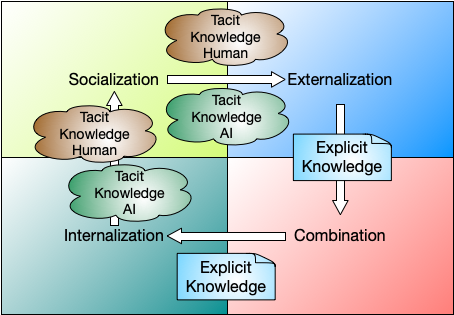
In the AI era, tacit knowledge inevitably exists in two forms—human/organizational tacit knowledge and AI tacit knowledge. By externalizing the tacit knowledge held by both humans and AI into a shared layer of explicit knowledge, these two kinds of tacit knowledge can be integrated.
Below, we examine how the AI Knowledge Creation Architecture behaves in relation to each phase of the SECI model.
Socialization
In the socialization phase, tacit knowledge is shared and a shared experience is formed.
In the AI Knowledge Creation Architecture, the tacit knowledge held by humans/organizations and the tacit knowledge held internally by AI (AI tacit knowledge) are indirectly shared through the BoK.
AI tacit knowledge cannot be directly observed, but it appears externally through generated output and connects back to human understanding when refluxed into the BoK.
In this phase:
-
Human/organizational tacit knowledge → propagates to AI through the BoK (explicit knowledge) - AI tacit knowledge → propagates to humans through generated content - Humans and AI form a “shared experience” mediated by the BoK Thus, an indirect and mediated form of socialization is established.
Externalization
In the externalization phase, tacit knowledge is expressed in language or models and recorded as shareable explicit knowledge.
In the AI Knowledge Creation Architecture, two types of externalization occur:
-
Human/organizational tacit knowledge → externalized as documents, models, and diagrams, then stored in the BoK 2. AI tacit knowledge → externalized as generated output (text, code, structured data), evaluated by humans, and then refluxed into the BoK Because AI tacit knowledge cannot be accessed directly, the “generated output” serves as an essential channel of externalization.
Furthermore, by consolidating both forms of knowledge into the explicit-knowledge layer of the BoK, a new shared context is created.
Externalization thus becomes a “hybrid externalization process” in which humans and AI collaboratively generate explicit knowledge.
Combination
In the combination phase, explicit knowledge is integrated and systematized.
In the AI Knowledge Creation Architecture, the following forms of combination occur:
-
Human/organizational editing and integration of the BoK - AI-driven reconstruction of explicit knowledge through BoK retrieval (RAG) - AI contextualizes and abstracts BoK knowledge, recombining it as assimilated knowledge - Humans integrate the generated outputs refluxed into the BoK, reorganizing them into more systematic explicit knowledge Here, the knowledge externalized by AI and the explicit knowledge organized by humans are reintegrated around the BoK, allowing the structure of knowledge to deepen and expand.
Combination is the central phase that improves the quality of the BoK, representing the stage where humans and AI cooperate to reinforce the knowledge system.
Internalization
In the internalization phase, externalized explicit knowledge is absorbed as tacit knowledge.
In the AI Knowledge Creation Architecture, internalization occurs in two directions:
-
Humans/organizations - Learn the knowledge registered in the BoK and internalize it as tacit knowledge through practical work and activities. 2. AI - Integrates explicit knowledge retrieved from the BoK into its context, forming assimilated knowledge and combining it semantically during reasoning. - Through knowledge promotion, this may be persistently incorporated into AI tacit knowledge when appropriate. Internalization is the process by which explicit knowledge is transformed back into tacit knowledge, and in the AI Knowledge Creation Architecture, its defining feature is a dual internalization structure in which both human and AI tacit knowledge grow.
On the human side, practical experiential knowledge accumulates, while on the AI side, implicit weights are updated through assimilated knowledge and promotion processes.
As a result, a knowledge-evolution loop is established in which both humans and AI develop their own tacit knowledge while sharing a common BoK.
Perspective
As AI becomes an active agent in knowledge creation, the boundary between human tacit knowledge and AI tacit knowledge will become increasingly blurred.
What is needed is the design of a knowledge architecture in which both continuously co-evolve through a shared explicit-knowledge layer (the BoK).
The AI Knowledge Creation Architecture presented in this article serves to connect the traditional SECI model with AI-native knowledge reflux, providing a foundation for building a hybrid knowledge-creation spiral that integrates human creativity with AI reasoning.
SimpleModeling will continue developing practical processes, including BoK management methods, RAG operation models, AI tacit knowledge update strategies, and organizational guidelines for AI utilization.
References
Glossary
- knowledge activation
-
Knowledge Activation is the process by which an AI initiates from an input prompt, retrieves relevant knowledge from external sources such as the BoK (Body of Knowledge) and the Retrieval Knowledge Base, as well as from its internal Pretrained Parametric Knowledge, and forms a coherent Context of Reasoning. At this stage, the AI reconstructs static knowledge into a “mobilized semantic space,” performing the core process of preparing for generation and understanding. Knowledge Activation precedes Knowledge Assimilation, functioning as the trigger that dynamically incorporates external knowledge into the AI’s internal state.
- BoK (Body of Knowledge)
-
At SimpleModeling, the core knowledge system for contextual sharing is called the BoK (Body of Knowledge). The goal of building a BoK is to enable knowledge sharing, education, AI support, automation, and decision-making assistance.
- AI tacit knowledge
-
Tacit knowledge implicitly retained within the AI. It exists as weights, internal representations, and reasoning patterns; it cannot be directly externalized, but manifests through generated output.
- knowledge creation spiral
-
A process in which knowledge expands spirally through repeated mutual transformation between tacit and explicit knowledge. It is treated as a core concept of the SECI model.
- Generative AI Reference Architecture
-
An architecture that organizes the internal processes executed by generative AI: knowledge activation, assimilation, expression, promotion, and circulation.
- SimpleModeling
-
SimpleModeling is a modeling-centered software development methodology and technology system for constructing a Domain Model from Knowledge, formalizing it in CML, realizing it as executable software through Cozy and AI, and running it on Textus.
- knowledge assimilation
-
A temporary internalization of external knowledge retrieved from the BoK through RAG. It enhances reasoning within a session but does not permanently modify the AI model’s parametric knowledge.
- knowledge expression
-
The process of producing externalizable outputs—such as text, code, models, or structured data—based on assimilated knowledge.
- Knowledge Promotion
-
A long-term integration process in which structured knowledge from the BoK is permanently incorporated into the model’s Pretrained Parametric Knowledge (PPK) through retraining or fine-tuning.
- knowledge circulation
-
Knowledge Circulation denotes the cyclical process in which knowledge is activated, assimilated, expressed, and promoted between AI and humans, then re-activated. Through this loop, knowledge generated by AI is organized and reintegrated into the SmartDox site or BoK (Body of Knowledge), allowing the whole system to evolve and deepen AI’s understanding and generative ability.
- Retrieval Knowledge Base
-
Retrieval Knowledge Base (RKB) is a structured, retrievable subset of Non-parametric Knowledge optimized for use by RAG (Retrieval-Augmented Generation). It contains indexed SmartDox documents, glossary entries, and semantic metadata, allowing AI models to fetch explicit knowledge as contextual input. Through RAG interaction, the RKB serves as a bridge for transforming external explicit knowledge into intermediate assimilated knowledge within the AI model.
- Pretrained Parametric Knowledge
-
Knowledge embedded within a generative AI model’s parameters, obtained through large-scale pretraining. It represents general linguistic, conceptual, and procedural understanding that the model can apply without explicit external input.
- Parametric Knowledge
-
Parametric knowledge refers to implicit knowledge embedded in the parameters (weights) of a neural network. It represents statistical or distributed information acquired during pretraining, rather than explicit facts stored in an external knowledge base. In RAG (Retrieval-Augmented Generation), it is contrasted with non-parametric knowledge, serving as the model’s internal “implicit value.”
- Retrieval-Augmented Generation (RAG)
-
A generation technique that supplements a language model’s internal (parametric) knowledge by retrieving relevant external information before generation. RAG systems first search knowledge sources such as databases or knowledge graphs and then use the retrieved context as input for text generation.
- Prompt
-
A structured instruction or contextual representation that bridges retrieved knowledge (RAG) and the AI model’s reasoning process. It transforms the structured knowledge from the BoK into a narrative or directive form that the model can interpret, act upon, and internalize.
- assimilated knowledge
-
A semantically integrated knowledge state within the AI, constructed from the context produced by knowledge activation. Corresponds to “understanding” within the AI.
- generated output
-
Artifacts produced through the knowledge-expression process of generative AI, including documents, code, summaries, and structured data.
- knowledge reflux
-
The process of extracting valuable knowledge from generated output and “returning” it to the BoK. A cyclical operation that reconstructs externalized knowledge as explicit knowledge.
- AI Knowledge Creation Architecture
-
A knowledge-creation architecture structured around AI tacit knowledge and the BoK, organizing the loops of activation, assimilation, expression, promotion, and reflux.
- Literate Model
-
Undefined
- SECI (Socialization Externalization Combination Internalization)
-
A model in which knowledge emerges through the spiral repetition of mutual transformation between tacit and explicit knowledge.
- Model
-
A Model is an abstraction that represents a subject according to a particular Purpose and Concern so that it can be understood, reasoned about, evaluated, or constructed. It is not the subject itself; it preserves the elements, relationships, and meanings required for its purpose.
- Socialization
-
The SECI phase in which tacit knowledge is shared and a shared experience is formed.
- Externalization
-
The SECI phase in which tacit knowledge is externalized into explicit knowledge such as language, models, and diagrams.
- Internalization
-
The SECI phase in which externalized explicit knowledge is internalized as tacit knowledge.
- Combination (Knowledge Combination)
-
The phase in which multiple pieces of explicit knowledge are integrated and reorganized into a more systematized body of knowledge.
- Activity
-
A concrete action or task performed within an Activity Space to move an Alpha to a more advanced state, typically producing or refining Work Products.
- knowledge creation loop
-
A cyclical knowledge-updating process in the AI era, in which documents (SmartDox), models (CML/SimpleModel), vocabularies (Glossary/Category), and design knowledge (BoK) are integrated through RDF, enabling AI to reference, generate, and improve knowledge, which is then reflected back into documentation.
- Persistence
-
Undefined
- Feature
-
In UML, a Feature is a structural or behavioral characteristic of Instances of a Classifier. Features include Structural Features such as Attributes and Behavioral Features such as Operations.